Institutional memory should not depend on a vendor contract
When learning records live only inside platforms that get replaced every few years, the organization forgets.
Read article →LearningUnify connects LMS, HRIS, SIS, content and assessment systems into a normalized intelligence layer, so migrations, audits and reporting stop depending on the platform that happened to hold the data.
Mergers, vendor consolidations, campus systems that were never designed to talk to each other. Each transition leaves completions, transcripts and compliance evidence stranded in a system someone is about to switch off.
Three learning platforms, two HR systems and a folder of CSV exports. Nobody can answer a simple question without a week of manual joins.
When the old LMS is retired, years of audit evidence go with it, or get frozen in a format no one can query.
New BI dashboards and AI pilots wait months because nobody knows where the data lives, who owns it or whether it can be used.
The LearningUnify Intelligence Platform sits beside the systems you already run. It extracts records through files, APIs, databases, xAPI streams, SFTP and cloud storage, then normalizes, reconciles and preserves them in one governed place.
Each one addresses a specific failure we have watched happen during migrations, audits and consolidations.
A neutral data and intelligence layer, not an LMS replacement. Your platforms stay; their data becomes portable.
Learning data remains accessible through platform changes, vendor consolidations and system retirement.
Extract, map, normalize, validate and move records so transcripts, completions, enrollments and history survive the transition.
Legal and compliance evidence kept in a governed, queryable layer when the original platform must be decommissioned.
LMS, HRIS, BI, compliance, skills and other systems connected on one normalized foundation for reporting and orchestration.
Who completed what, when, under which course version and requirement, preserved across role and system changes.
Metadata and usage normalized to expose duplicates, outdated material, orphaned content and licensing waste.
Existence, ownership, permissions, lineage, privacy and governance documented so pilots stop stalling.
Dashboards, BI exports, integrations and audit pulls powered by stored, normalized learning records.
Because completions are stored with the version, requirement and reconciled identity in force at the time, an audit is a query rather than a reconstruction. Every row in the result carries its source references.
Every record class is extracted from each source, mapped to the common model, validated against the original and only then moved. History the new platform cannot hold stays in the governed layer.
How migration works →Inventory record classes, owners and volumes across all three sources.
Full pulls into staging; identities merged with a reviewable log.
Counts and samples signed off per record class.
Current records loaded to the new LMS; full history preserved.
Before the contract ends, everything is captured: records, versions, requirements, certificates and attachments, with original identifiers. The archive stays queryable, owned and governed.
Historical preservation →Which records must be kept, for how long, for whom.
Exports, API pulls and backups combined; gaps documented.
Counts checked, owners and retention assigned.
Archive answers its first audit pull the same week.
Instead of point-to-point pipes between each pair of systems, every tool reads from and writes to one normalized store, with identity reconciled once and every transfer logged.
Cross-system integration →The governance inventory records, for every learning dataset, whether it exists, where it lives, who owns it, who may use it, where it came from and how good it is. That is the context AI and analytics projects keep asking for.
AI readiness →| Dataset | Owner | Lineage | Quality | Usable |
|---|---|---|---|---|
| Completions · LMS-A | L&D Ops | Complete | 98% | Yes |
| Assessments · vendor | Compliance | Complete | 96% | Yes |
| Legacy LMS archive | HR Tech | Recovered | 91% | Yes, flagged |
| Site spreadsheets | Unassigned | Partial | — | Not yet |
Metadata and usage from every library are normalized into one catalogue. Duplicates, superseded versions, orphaned items and unused licences become visible in a single view, with a ranked list of what to keep, consolidate, retire or renegotiate before the next budget cycle.
SIS replacements, LMS transitions and decades of transcripts that must survive them.
Learn more →Regulated training evidence that must hold up years after the recording platform is gone.
Learn more →Credentialing, mandatory training and continuing education across facilities and systems.
Learn more →Proof of safety training for every worker, on every site, under every rule that applied.
Learn more →Institutional memory that survives reorganizations, procurement cycles and platform retirements.
Learn more →Global enterprises consolidating regional platforms into one reporting picture.
Learn more →Every engagement starts from a real situation: a migration on a deadline, an audit request, a platform about to be switched off, or a pilot that cannot start until someone finds the data.
Move records between platforms without losing history. Extract, map, normalize, validate and move learning records so transcripts, completions and enrollments survive the transition intact.
Learn more →Keep evidence queryable after a platform is retired. Maintain legal and compliance learning evidence in a governed layer when the original system has to be decommissioned.
Learn more →Defensible audit pulls in minutes, not weeks. Preserve who completed what, when, under which course version and requirement, even across role and system changes.
Learn more →One normalized foundation for every downstream tool. Connect LMS, HRIS, BI, compliance and skills systems for unified reporting and workflow orchestration.
Learn more →See what you own, what is used and what is wasted. Normalize content metadata and usage to find duplicates, outdated material, orphaned items and licensing waste.
Learn more →Inventory the landscape before the pilot starts. Document existence, ownership, permissions, lineage, privacy and gaps so new projects stop stalling on missing context.
Learn more →The same pipeline serves a one-time migration and an ongoing integration. Nothing is thrown away, and every record can be traced back to where it came from.
Files, APIs, databases, xAPI streams, SFTP and cloud storage from LMS, HRIS, SIS, content and assessment systems.
Map fields to a common model, merge identities, flag quality issues, keep the original values alongside the cleaned ones.
Store records with lineage, permissions and ownership so they remain accessible after any platform change.
Dashboards, BI exports, audit pulls, controlled data movement, skills analysis and AI workflows read from one trusted source.
Governance is recorded as data, not as a document nobody updates. Access is role-based and logged. Hosting is within the European Union by default. Customer data is never used to train models.
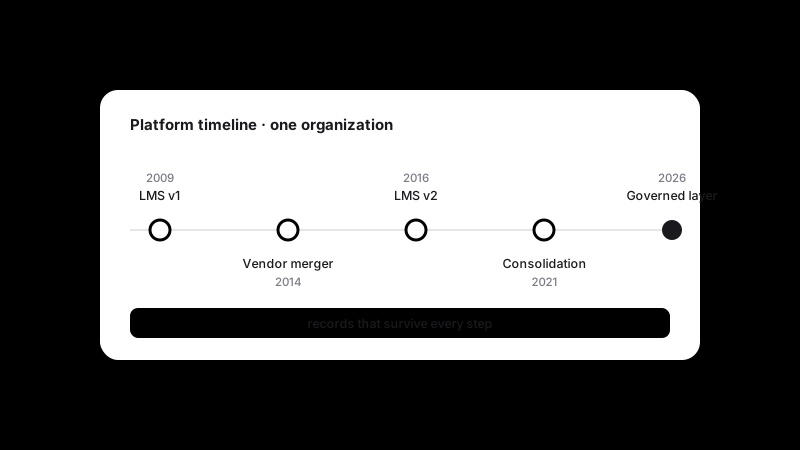
When learning records live only inside platforms that get replaced every few years, the organization forgets.
Read article →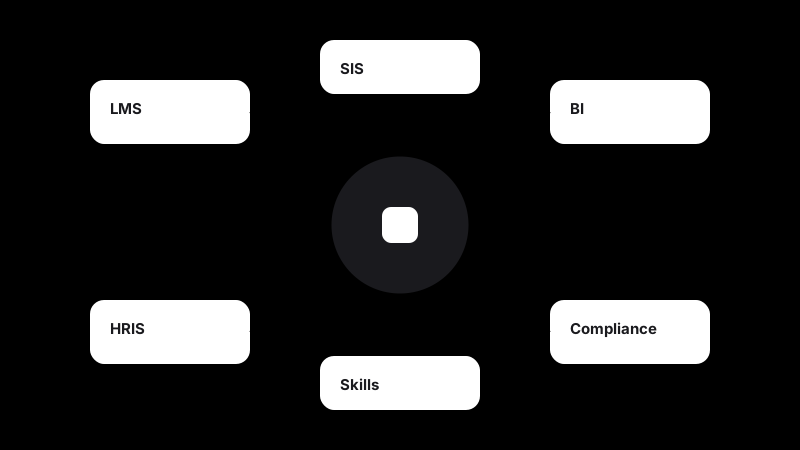
The easiest product to sell is another platform. We built a layer instead.
Read article →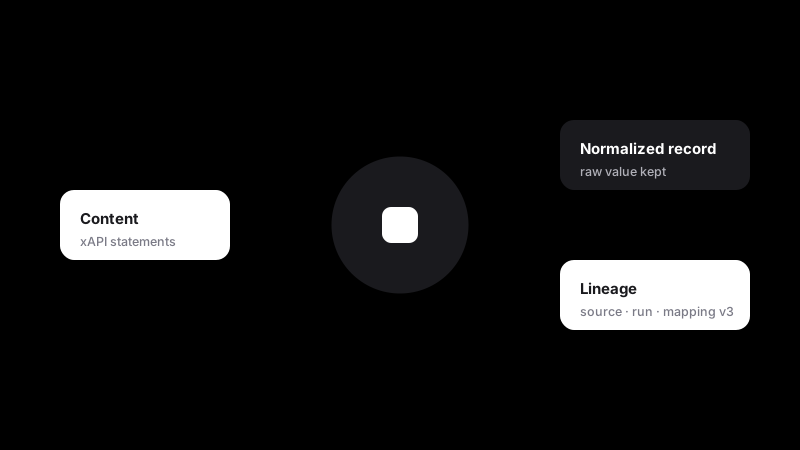
The important question is whether you can trace every number back to where it came from.
Read article →Get one view across every platform without waiting on a vendor roadmap.
Learn more →Run consolidations and integrations with a clear map of what moves where.
Learn more →Keep ownership, permissions and lineage documented as systems change.
Learn more →No. LearningUnify is a neutral data and intelligence layer that sits beside your existing systems. It is designed so you do not have to rip anything out to get value.
They stay in the governed layer with full lineage, permissions and version history, so you can still run audit pulls and reports after the original system is gone.
Through whatever the source supports: file exports, APIs, direct database access, xAPI streams, SFTP drops and cloud storage. Our services team handles the mapping.
We work with enterprise L&D teams and institutions of many sizes. The common factor is fragmented learning data and a transition on the horizon.
Tell us which systems you run and we will show how the platform connects, normalizes and preserves their records.